
Visible seams and wrinkles almost always come from the install, not the turf. Seams show when pieces are laid with the grain running different ways, joined with gaps, or not glued down properly. Wrinkles and ripples come from turf that wasn't stretched and secured, from heat expansion with loose edges, or from a base that settled. Good seaming and a compacted base prevent both.
Why seams show
- Grain running different ways: turf fibers lean slightly in one direction. If two pieces face different ways, the color looks different and the seam stands out.
- Gaps or overlaps: edges that aren't trimmed and butted tight leave a line you can see.
- Poor adhesive: seams that weren't glued properly can open up over time.
- A soft base: if the ground under a seam settles, the seam pulls apart.
Why turf wrinkles
Turf expands a bit in summer heat. If it wasn't stretched tight and secured at the edges, it can ripple. Wrinkles that show up after the first winter usually mean the base moved underneath. The animation below shows how a thin base lets turf settle and wrinkle.
Install day: thin, loose base. Looks fine.
Install day: 3–4 inches of road base, compacted in lifts.
How we prevent it
- Every piece is laid with the grain running the same direction.
- Seams are trimmed, butted tight and joined with seam tape and adhesive.
- Edges are secured where turf meets rock, beds or concrete.
- The base is dug 3 to 4 inches and compacted in lifts to 90% or better, so it doesn't settle.
Fixing seams and wrinkles
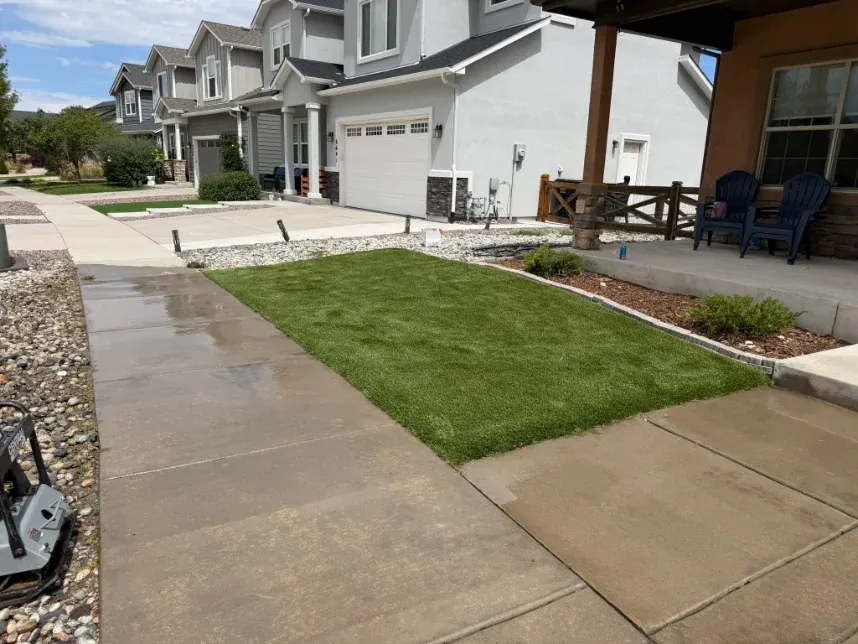
A seam that opened can usually be re-glued. Wrinkles from loose edges can often be stretched and re-secured. If the base has settled, the right fix is pulling the turf back, rebuilding the base and relaying it. We can tell you which it is.
Questions
Can you hide artificial turf seams?
Yes. With the grain running the same way, tight edges and proper adhesive, seams are hard to spot.
Why is my turf rippling?
Usually it wasn't stretched and secured at the edges, or the base underneath has settled.
Can a separated seam be fixed?
Usually. The seam is re-glued and, if the base under it sank, the base is fixed first.
Do more seams cost more?
Yes. Layouts with lots of cuts and seams take more time and material, which moves a quote toward the top of the $10 to $20 per square foot range.
 Turf install process
 Artificial turf
 How long turf lasts